Wich Art of Our Govern Ment Makes Enactss and Oasse Laws
In Australia the three levels of government work together to provide us with the services we need. This in-depth paper explores the roles and responsibilities of each level, how they raise money and how they piece of work together. Instance studies show how the powers of the Australian Parliament have expanded.
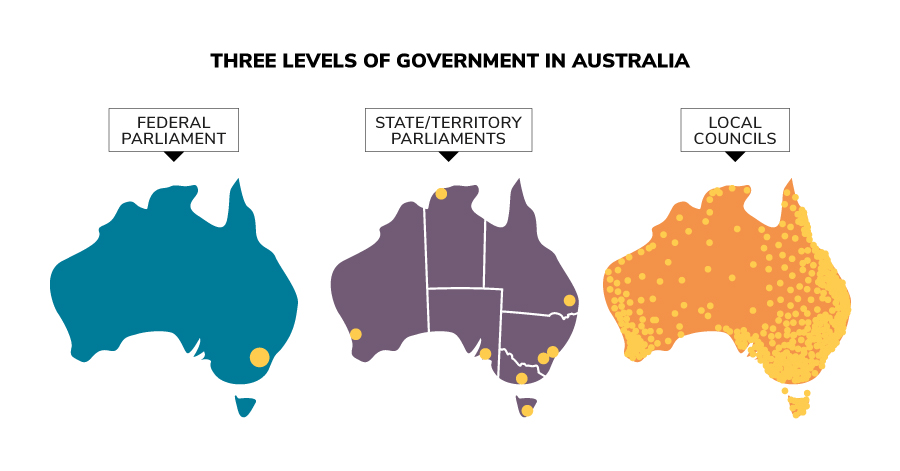
Three levels of government in Australia.
Parliamentary Education Office (peo.gov.au)
Iii levels of regime in Australia.
Parliamentary Education Office (peo.gov.au)
Description
This diagram illustrates the three levels of government—the law-making bodies in Australia with three maps of Australia: Local councils (located around Australia in each local council division); State/territory parliaments (located in the upper-case letter cities of each of the vi states and 2 territories); and federal Parliament (located in Canberra, the nation'due south capital).
Copyright information

This work is licensed nether a Creative Commons Attribution-NonCommercial-NoDerivs 3.0 Unported License.
You are gratuitous to share – to copy, distribute and transmit the work.
Attribution – you must attribute the work in the way specified by the author or licensor (but non in whatever way that suggests that they endorse yous or your use of the work).
Non-commercial – you may not use this work for commercial purposes.
No derivative works – y'all may not modify, transform, or build upon this work.
Waiver – whatever of the above conditions can be waived if yous get permission from the copyright holder.
Australia has three levels of authorities that work together to provide us with the services we need.
The three levels are:
- federal Parliament—makes laws for the whole of Australia
- half dozen country and 2 mainland territory parliaments—make laws for their state or territory
- over 500 local councils—make local laws (by-laws) for their region or district.
How the federal and state parliaments work together is sometimes referred to as the division of powers.
Each level of authorities has its own responsibilities, although in some cases these responsibilities are shared.
Australians anile 18 years and over vote to elect representatives to federal, country and territory parliaments, and local councils to make decisions on their behalf. This means Australians accept someone to represent them at each level of authorities.
History
The establishment of the 3 levels of Australian government was an upshot of Federation in 1901, when the six British colonies—New South Wales, Western Australia, Queensland, Victoria, Due south Australia and Tasmania—united to form the Commonwealth of Australia. Upward until the 1850s each colony was run by a non-elected governor appointed by the British Parliament.
By 1860 all the colonies, apart from Western Commonwealth of australia, had been granted partial cocky-government past Britain. (Western Commonwealth of australia became self-governing in 1890). Each had its own written constitution, parliament and laws, although the British Parliament retained the power to make laws for the colonies and could over-rule laws passed by the colonial parliaments. Past the end of the 19th century, many colonists felt a national government was needed to deal with bug such as defence, immigration and trade.
For Federation to happen, it was necessary to notice a manner to unite the colonies every bit a nation with a central or national government, while allowing the colonial parliaments to maintain their authorization. The Australian Constitution, which sets out the legal framework by which Australia is governed, resolved this effect by giving Australia a federal system of government. This means ability is shared between the federal - Australian - regime and country governments.
Under the Constitution us kept their ain parliaments and most of their existing powers but the federal Parliament was given responsibleness for areas that afflicted the whole nation. Country parliaments in turn gave local councils the chore of looking later on the particular needs of their local communities.
Making laws
Federal Parliament
The Constitution established an Australian - federal - Parliament. The 227 members of the Australian Parliament—76 in the Senate and 151 in the Firm of Representatives—are responsible for making federal laws.
Sections 51and52 of the Constitution describe the police force-making powers of the federal Parliament. Department 51 lists 39 areas over which the federal Parliament has legislative - constabulary-making - power. These include:
- international and Australian merchandise and commerce
- defence
- postal and telecommunications services
- cyberbanking and insurance
- strange policy
- citizenship
- taxation
- pensions
- census and statistics
- welfare payments
- currency
- Medicare
- national employment conditions
- marriage and divorce
- immigration
Under section 51 of the Constitution, state parliaments tin refer matters to the federal Parliament. That is, they can ask the federal Parliament to make laws well-nigh an effect that is otherwise a state responsibility. Any federal police force and then made about the issue merely applies in the land or states who referred the affair to federal Parliament or who decide to adopt the law.
Some of the powers listed in department 51 are exclusive powers of the federal Parliament; that is, only the federal Parliament tin make laws in these areas. Some powers are shared with the state and territory parliaments. These powers are said to be concurrent. Exclusive powers of the federal Parliament are also included in sections 52, 86, 90, 114, 115 and 122.
Examples of exclusive and concurrent powers
Exclusive POWERSof the federal Parliament | CONCURRENT POWERSpowers shared past the federal Parliament, and the state and territory parliaments |
| Section 51
Department 52
Sections 86 and 90
Sections 114 and 115
Section 122
| Instruction
Surround
Health
Marriage and divorce
Overseas trade
Taxation
|
Considering the federal Parliament and the land parliaments tin can make laws in the same areas, sometimes these laws conflict. Section 109 of the Constitution states that if the federal Parliament and a country parliament pass conflicting laws on the same subject field, then the federal constabulary overrides the land constabulary or the part of the state police that is inconsistent with it.
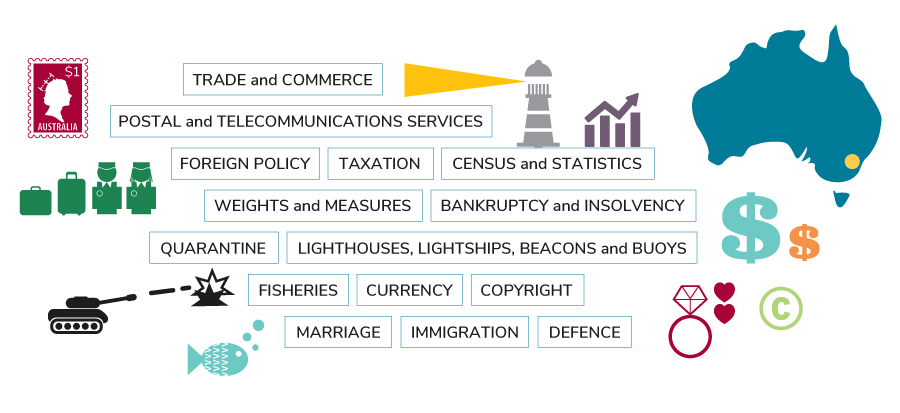
The law-making powers of the federal Parliament.
Parliamentary Teaching Role (peo.gov.au)
The law-making powers of the federal Parliament.
Parliamentary Education Office (peo.gov.au)
Description
The law-making powers of the federal Parliament include:
- Merchandise and commerce
- Postal and telecommunications services
- Forging policy
- Taxation
- Census and statistics
- Weights and measures
- Bankruptcy and insolvency
- Quarantine
- Lighthouses, lightships, beacons and buoys
- Fisheries
- Currency
- Copyright
- Matrimony
- Immigration
- Defence
Copyright information
This work is licensed under a Creative Commons Attribution-NonCommercial-NoDerivs 3.0 Unported License.
You lot are free to share – to copy, distribute and transmit the piece of work.
Attribution – you must attribute the piece of work in the mode specified by the writer or licensor (only not in any manner that suggests that they endorse you or your employ of the work).
Non-commercial – you may not use this work for commercial purposes.
No derivative works – you may not alter, transform, or build upon this work.
Waiver – whatsoever of the above conditions can be waived if you go permission from the copyright holder.
Country and territory parliaments
Australia has 6 state parliaments. It besides has 2 territory parliaments known as legislative assemblies. These parliaments are located in Australia'south 8 capital cities.
Each country, apart from Queensland, has a parliament that consists of ii houses. The Queensland Parliament has only one house—the Legislative Assembly—making it unicameral - unmarried-firm.
The Northern Territory and the Australian Capital Territory parliaments are also unicameral— both have one firm called the Legislative Assembly. The Australian Capital Territory is unique in Australia because its parliament combines the responsibilities of both a local and country government.
Section 122 of the Constitution gives the federal Parliament the power to make laws for the territories. Until they were granted cocky-government, the Northern Territory and Australian Capital Territory were administered - managed - by the federal authorities. Federal Parliament gave the territories self-government by passing theNorthern Territory (Cocky-Authorities) Deed 1978 and theAustralian Majuscule Territory (Cocky-Authorities) Act 1988.
Other territories
In that location are 8 Australian territories in addition to the Australian Capital Territory (ACT) and Northern Territory (NT):
- Ashmore and Cartier Islands
- Australian Antarctic Territory
- Christmas Island
- Cocos (Keeling) Islands
- Coral Bounding main Islands
- Jervis Bay Territory
- Norfolk Island
- Territory of Heard Island and McDonald Islands.
These territories are governed according to Australian - federal - law and the laws of a state, the Deed or NT. Near have an appointed Administrator.
State and territory parliaments make laws that are enforced within their country or territory. Past defining federal powers, the Australian Constitution reserved - left - about other law-making powers to the states. These are called residual powers. As a dominion, if it is non listed in sections 51 and 52 of the Constitution, information technology is an area of state responsibleness. State laws chronicle to matters that are primarily of state interest such as:
- schools
- hospitals
- roads and railways
- public transport
- utilities such as electricity and h2o supply
- mining
- agriculture
- forests
- community services
- consumer affairs
- police
- prisons
- ambulance services
Section 122 of the Constitution allows the Parliament to override a territory police at any time. The federal Parliament has only used its power under section 122 a few times and only in cases where the territory police force has created much debate or controversy within the Australian community.
Up until 2011 the self-government Acts roofing the Northern Territory and the Australian Capital letter Territory gave federal ministers the right to veto or alter territory laws without approval of federal Parliament. This veto power was used by Prime Minister John Howard in 2006 to disallow the Australian Upper-case letter Territory's ceremonious wedlock laws. Federal Parliament has at present amended the self-authorities Acts and so the federal Parliament must vote to veto a territory law.
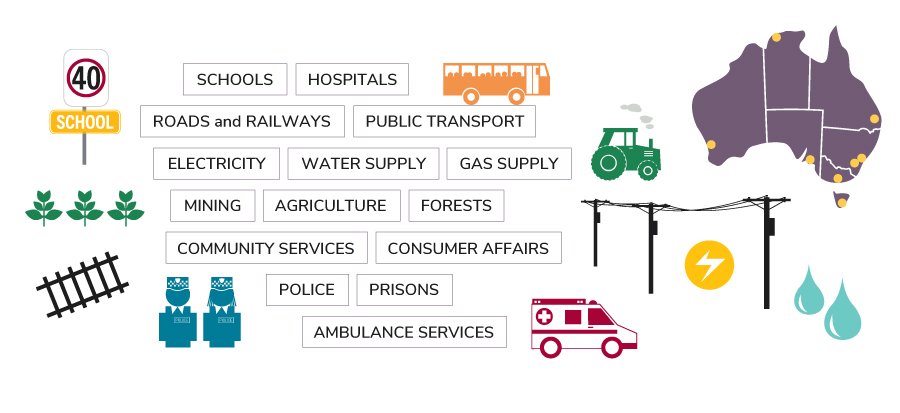
The law-making powers of country parliaments.
Parliamentary Education Office (peo.gov.au)
The police-making powers of state parliaments.
Parliamentary Education Role (peo.gov.au)
Description
The law-making powers of the country parliaments include:
- Schools
- Hospitals
- Roads and railways
- Public transport
- Electricity
- Water supply
- Gas supply
- Mining
- Agronomics
- Forests
- Community services
- Consumer affairs
- Law
- Prisons
- Ambulance services
Copyright information
This work is licensed under a Artistic Commons Attribution-NonCommercial-NoDerivs 3.0 Unported License.
Yous are complimentary to share – to copy, distribute and transmit the work.
Attribution – you must attribute the piece of work in the mode specified by the author or licensor (but not in any way that suggests that they endorse you or your apply of the work).
Not-commercial – you may not employ this piece of work for commercial purposes.
No derivative works – you may not alter, transform, or build upon this piece of work.
Waiver – any of the above conditions can be waived if you get permission from the copyright holder.
1997
In 1997 federal Parliament passed a law to overturn the Rights of the Terminally Ill Act 1995 (NT), which fabricated euthanasia legal in the Northern Territory. The territory police force allowed terminally ill patients to decide when to dice. Later on a gratis vote the federal Parliament passed the Euthanasia Laws Act 1997. Equally a outcome of this police force, the cocky-regime Acts of the territories were inverse to stop the territory parliaments making laws about euthanasia.
Councils
In that location are over 500 local authorities bodies beyond Australia. They are ofttimes called councils, municipalities or shires. Local governments consist of 2 groups who serve the needs of local communities:
- elected members, who usually have iv-year terms
- staff who work for the council.
On average each quango has 9 elected members who are usually called councillors or aldermen, while the chair or caput of the council is usually chosen the mayor or president. These smaller legislative bodies make by-laws about local matters and provide services. For example, councils are responsible for:
- local roads, footpaths, cycle ways, street signage and lighting
- waste product direction, including rubbish collection and recycling
- parking
- recreational facilities such as parks, sports fields and swimming pools
- cultural facilities, including libraries, fine art galleries and museums
- services such as childcare and anile care
- sewerage
- town planning
- building approvals and inspections
- land and coast care programs
- pet control.
1 of the principal tasks of local authorities is to regulate - manage - services and activities. For case, councils are responsible for traffic lights, and canis familiaris and cat registration. These tasks would exist difficult for a state government to manage because they are local bug.
Councils tin evangelize services adapted to the needs of the community they serve. For instance, the needs of residents in inner-city Brisbane might be different to those of people living in rural Queensland. Past providing these services and facilities, councils make sure local communities piece of work well from twenty-four hours-to-day.
From the 1840s colonial parliaments began to hand over responsibility for local bug to local councils. The first quango was established in Adelaide in 1840, followed in 1842 by the Metropolis of Sydney and Town of Melbourne councils. From the 1850s onwards, the number of elected councils grew speedily.
Today, local government include urban center councils in urban centres, and regional and shire councils in rural areas. On average each quango looks after about 28 400 people. The largest council by population is Brisbane City Council which is responsible for a population of nearly 1.2 million. The Shire of Eastward Pilbara in Western Australia is the largest local authorisation expanse.
Local councils are not mentioned in the Australian Constitution, although each state has a local government Act - police force - that provides the rules for the creation and performance of councils.
While these Acts vary from state to country, in general they embrace how councils are elected and their power to make and enforce local laws, known as by-laws. A by-law is a form of delegated legislation because the state authorities delegates - gives - to councils the potency to make laws on specific matters. Every bit councils derive their powers from state parliaments, quango by-laws may be overruled past state laws.
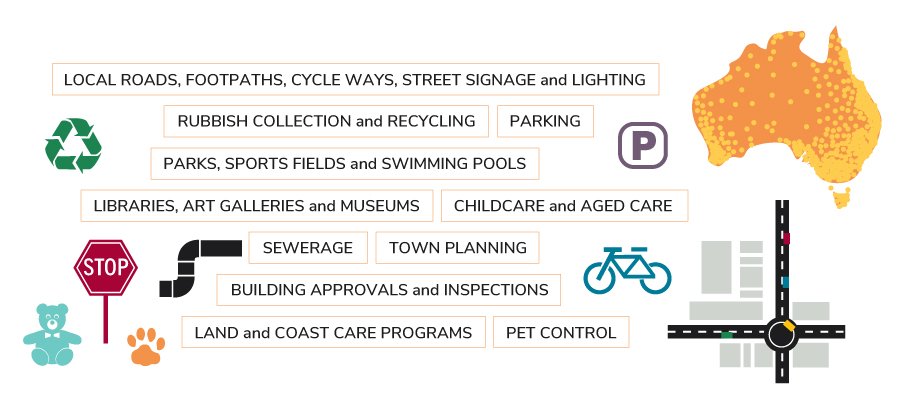
The law-making powers of local regime.
Parliamentary Education Office (peo.gov.au)
The law-making powers of local regime.
Parliamentary Education Office (peo.gov.au)
Description
The police force-making powers of local governments include:
- Local roads, footpaths, wheel ways, street signage and lighting
- Rubbish drove and recycling
- Parking
- Parks, sports fields and swimming pools
- Libraries, art galleries and museums
- Childcare and aged care
- Sewerage
- Town planning
- Building approvals and inspections
- Land and coast care programs
- Pet command
Copyright information
This work is licensed nether a Creative Eatables Attribution-NonCommercial-NoDerivs three.0 Unported License.
You are free to share – to copy, distribute and transmit the work.
Attribution – you must aspect the work in the style specified by the author or licensor (but not in any style that suggests that they endorse you or your employ of the piece of work).
Not-commercial – you may not apply this work for commercial purposes.
No derivative works – you may not alter, transform, or build upon this work.
Waiver – any of the above conditions tin exist waived if you become permission from the copyright holder.
Putting laws into action
Each of the 3 levels of government has its own executive that puts laws into action.
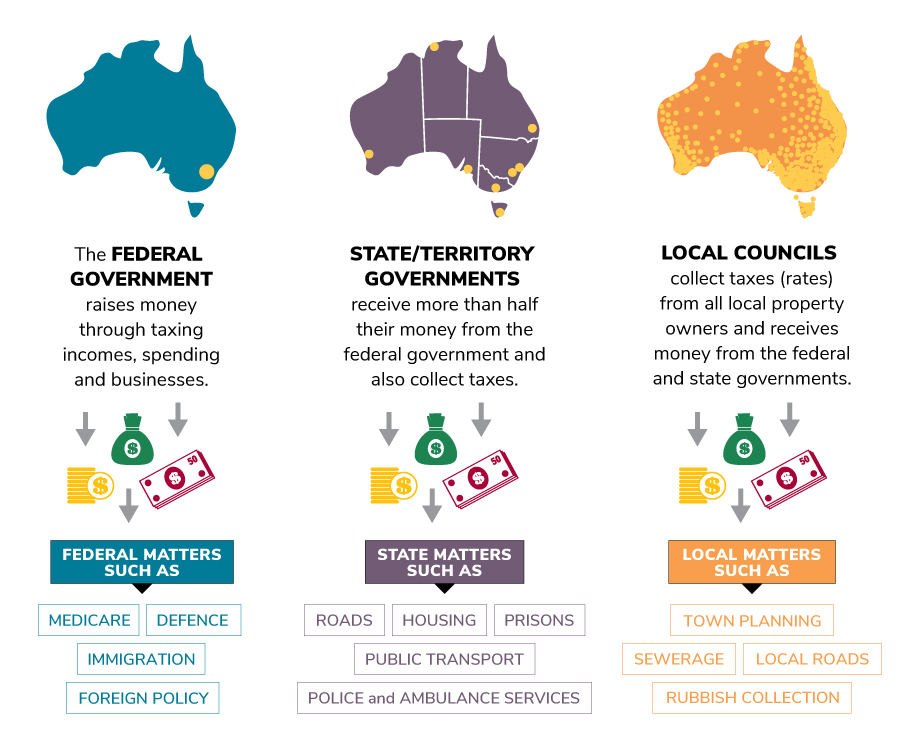
How governments in Australia enhance and spend coin.
Parliamentary Pedagogy Office (peo.gov.au)
How governments in Australia raise and spend money.
Parliamentary Education Office (peo.gov.au)
Clarification
This diagram shows how governments enhance and spend money.
The federal government raises money through taxing incomes, spending and businesses. The money is spent on federal matters such every bit: Medicare, defence force, immigration, foreign policy.
State/territory governments receive more half their money from the federal authorities and also collect taxes. The money is spent on state matters such every bit: roads, prisons, housing, public transport, constabulary and ambulance services.
Local councils collect taxes (rates) from all local belongings owners and receives money from the federal and land governments. The money is spent on local matters such as: town planning, rubbish collection, water and sewage, domestic dog registration and local roads.
Copyright data
This work is licensed nether a Creative Commons Attribution-NonCommercial-NoDerivs 3.0 Unported License.
You are complimentary to share – to copy, distribute and transmit the work.
Attribution – you must attribute the piece of work in the mode specified by the author or licensor (but not in any way that suggests that they endorse you or your use of the work).
Non-commercial – you lot may not use this work for commercial purposes.
No derivative works – you may not alter, transform, or build upon this work.
Waiver – whatever of the above weather tin can be waived if you get permission from the copyright holder.
Federal executive government
The federal executive - the Prime number Minister and ministers - is the master decision-making body of the Australian Government and is responsible for putting federal laws into action. Information technology also makes sure laws provide Australians with the services they demand.
If a government minister needs to introduce a new law or modify an existing i, they must first get the approving of the federal executive. The government minister then works with their government department to set up the bill - proposed constabulary - earlier information technology is considered past the Parliament.
The executive authorities needs money to put laws into activity. It raises money by collecting taxes on incomes and company profits, and through other charges such as fuel excise and customs duties.
| Federal | Country and territory | Local |
| The federal government raises money to run the state by collecting taxes on incomes, goods and services, and company profits, and spends it on national matters: for instance, merchandise, defense and immigration. | State and territory governments also raise coin from taxes but receive more than than one-half their coin from the federal government and spend it on state and territory matters: for instance, schools, housing, hospitals, roads and railways, police and ambulance services. | Local councils collect taxes - rates - from all local property owners and receive grants from federal, state and territory governments, and spend this on local matters: for example, town planning, rubbish drove, water and sewerage, local roads and pet control. |
Once a year the Treasurer delivers the Upkeep to Parliament, which explains how the government will heighten and spend this money. The regime must gain approving for its Budget from Parliament. It does this past request Parliament to pass a series of bills called Cribbing Bills.
Ministers manage the share of the Budget that has been given to the department they are responsible for. They employ this money to administer the laws and programs that fall within their portfolio. The executive regime besides gives revenue - money - collected through the tax on goods and services (GST) to the states and territories to help fund their delivery of services.
State and territory executives
States and territories also have executive governments; in that location are 6 land and two territory executive governments. State executive governments are fabricated up of a premier and state ministers. Territory executive governments are fabricated upwards of a principal minister and territory ministers. These ministers are elected members of the state or territory parliament, and come from the party or coalition of parties that forms regime in the lower house. Country and territory executives decide on policy and new laws, including how to put land or territory laws into activity.
Land and territory executive governments get most half their coin, including their share of the goods and services tax (GST), from the federal executive regime. They also raise money from taxes and charges such as:
- stamp duty—a tax on legal documents
- payroll revenue enhancement—a tax on the total amount of salaries paid by an employer
- motor vehicle registration
- country revenue enhancement—a taxation paid by certain land owners on the unimproved value of their property, including holiday homes, investment properties and vacant land
- gambling licenses.
The states and territories spend this coin to manage laws and to provide goods and services to the people of their state or territory. Land and territory ministers, like federal ministers, manage the budget given to the government department they are responsible for.
The local executive
Elected councillors decide on policy and make by-laws for their customs at council meetings. These decisions are so administered - put in place - by the chief executive officeholder and other non-elected employees of the quango.
Local governments receive part of their income in grants from federal, state and territory executive governments. Councils also raise their own money from local taxes such as rates - tax on the value of property - sewerage and water charges, domestic dog licences and user fees for sporting facilities and libraries.
Changes in the federal and state relationship
Since federation some rulings made by the High Court of Australia have strengthened the constabulary-making powers of the federal Parliament. The High Court tin can resolve disagreements betwixt the federal and state governments over their constabulary-making powers. If a law is contested - challenged - it is up to the High Court to decide whether the Constitution gives the relevant parliament the power to make this law. A law judged by the Loftier Court to be unconstitutional is then invalid - over-ruled.
The states' reliance on federal authorities funding to pay for activities such as schools and hospitals has too shifted the federal-state balance. Federal funding grants brand up nigh half of the states' total revenue. Under section 96 of the Constitution, the federal Parliament can 'grant fiscal assistance to any State on such terms and atmospheric condition as Parliament thinks fit'. This allows the federal government to requite 'tied' grants to land governments, directing the state government on how to spend the money. The federal government tin can and so influence the way things are done in areas such as educational activity, health, housing and ship, which are primarily state responsibilities.
The constabulary-making powers of the federal Parliament have also grown to deal with the huge social and technological advances that have occurred since federation. As Australian order has changed, so too take the issues facing federal Parliament. For instance, the drafters of the Constitution could not have foreseen how the digital revolution has impacted the style we live, piece of work and communicate. In 1901 at that place were simply 33 000 telephones in Australia and no radio, television, computers or internet. Today the federal Parliament makes laws nigh all of these services. It is able to practice this under section 51(v) of the Constitution, which gives Parliament responsibleness for 'postal, telegraphic, telephonic and other like services'.
Cooperation
Members of the federal, state and local executives are required to piece of work together in order to solve complex problems.
The National Cabinet, which includes the Prime Minister, premiers, and main ministers, meets regularly to discuss intergovernmental matters.
Ministers from the various levels of regime also work together on matters of mutual concern. For instance, the Australian Health Ministers' Informational Council meets regularly to negotiate a coordinated national approach to health policy.
As a result of intergovernmental discussions, uniform national laws have been made to tackle issues such equally road transport, food standards and consumer rights. By introducing uniform national laws, the 3 levels of regime can operate together with a greater level of efficiency.
Example written report 1
Radio Licence Case 1935
Until 1974 the federal government charged households a fee or listener'southward licence for each radio fix they owned. The fees were used to pay for radio stations. In 1934 Dulcie Williams from Surry Hills in Sydney refused to pay the listener's licence on the grounds wireless radio is not mentioned in the Constitution. In doing so she challenged the federal Parliament'south correct to make laws virtually dissemination.
The case went to the High Courtroom, who found in favour of the regime based on section 51(v) of the Constitution. This department gives federal Parliament responsibleness for 'postal, telegraphic, telephonic and other like services'. The Court decided wireless radio could be defined as being like a telegraphic or telephonic service because it involved sending communications.
The High Courtroom'south interpretation of section 51(v) means that today the federal Parliament can brand laws almost all forms of communication, including tv set and the net. For instance, it has passed laws to regulate the apply of the cyberspace, tackle cyber criminal offense and invest in infrastructure such equally the National Broadband Network.
Case report 2
Tasmanian Dam Case 1983
In 1978 the state-owned Tasmanian Hydro-Electric Commission announced plans to dam the Franklin River and flood a large wilderness area in south-west Tasmania. Iv years later the surface area was alleged a World Heritage site under the Earth Heritage Convention, to which the federal government is a signatory—Commonwealth of australia has agreed to the convention.
The federal Parliament and then passed laws to stop clearing and excavation within the newly listed Tasmanian Wilderness Earth Heritage expanse. The Tasmanian authorities challenged the laws in the High Court of Australia, arguing the federal Parliament did non take the power to stop the structure of the dam.
In 1983 the High Court ruled that, under its external diplomacy power, the federal Parliament could make laws relating to international treaties which Commonwealth of australia had signed. The external affairs power, listed in section 51(xxix) of the Constitution, allows the federal Parliament to enter into international treaties and agreements on behalf of Commonwealth of australia.
Although the federal Parliament has no law-making powers over Tasmania's rivers, dams or environment, the court decided the federal legislation was valid because it allowed the government to meet its commitments under an international treaty—the World Heritage Convention.
When the Constitution was written, treaties mainly related to peace and trade simply today they also deal with matters that are divers every bit state responsibilities—for case, human rights, environmental protection and discrimination. Equally a result of the High Court ruling, the federal government can now make laws in these and other areas in gild to honour treaty agreements.
Example study 3
The Great Barrier Reef Marine Park
In the 1960s and 1970s the Queensland government sought to commercialise the natural resources of the Keen Bulwark Reef. In response, the growing environmental movement organised protests against the expansion of mining and oil drilling in this sensitive environment.
In 1969 the federal and Queensland governments jointly established an inquiry into the 'possibility' of oil drilling causing harm to the reef. This research was upgraded to the federal Royal Commission into Exploratory and Production Drilling for Petroleum in the Surface area of the Not bad Barrier Reef, which recommended the creation of a marine park to protect the Reef.
In response the federal and Queensland governments agreed to ban oil drilling in the territorial waters they controlled and the federal Parliament passed the Great Barrier Reef Marine Park Act 1975. This created a federal agency to grow and administer the new park in conjunction with the Queensland government.
The Queensland Government manages the 24-hour interval-to-day operations of the Park, including undertaking state responsibilities such as issuing angling and tourism operator licenses. The federal and Queensland governments work with local councils along the Queensland coast to protect and preserve the marine park. For instance, local councils are responsible for stormwater treatment, ensuring h2o running into the reef is free from pollutants.
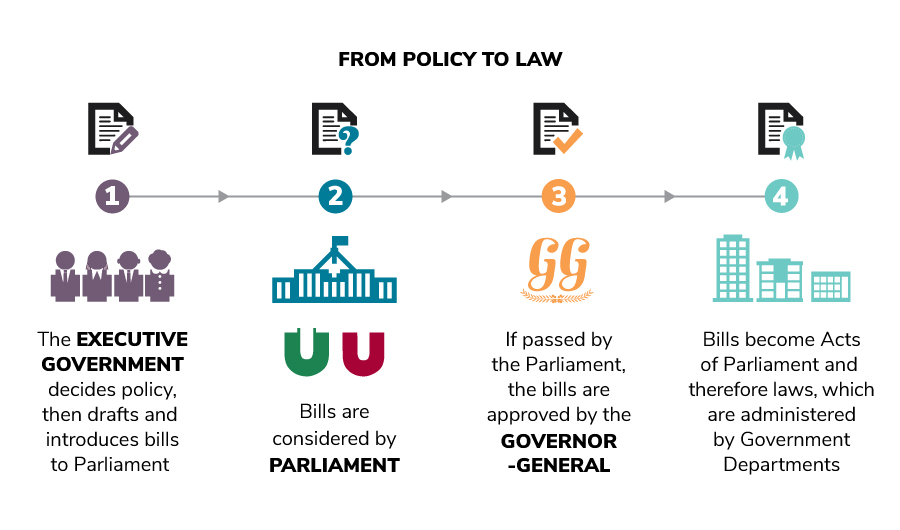
From policy to police.
Parliamentary Education Office (peo.gov.au)
From policy to law.
Parliamentary Education Office (peo.gov.au)
Description
This diagram illustrates the role of executive government in turning policy into law.
one. The executive government decides policy and then drafts and introduces bills to the Parliament.
2. Bills are considered past the Parliament.
3. If passed past the Parliament, the bills are approved by the Governor-General.
four. Bills become Acts of Parliament and therefore laws, which are administered by government departments.
Copyright information
This work is licensed under a Creative Commons Attribution-NonCommercial-NoDerivs iii.0 Unported License.
You are costless to share – to copy, distribute and transmit the work.
Attribution – you must attribute the piece of work in the manner specified by the writer or licensor (merely not in any way that suggests that they endorse you or your employ of the piece of work).
Non-commercial – you may not utilise this work for commercial purposes.
No derivative works – y'all may non alter, transform, or build upon this work.
Waiver – any of the higher up conditions tin can be waived if yous get permission from the copyright holder.
Source: https://peo.gov.au/understand-our-parliament/how-parliament-works/three-levels-of-government/three-levels-of-government-governing-australia/

Postar um comentário for "Wich Art of Our Govern Ment Makes Enactss and Oasse Laws"